
 By
·
3 minute read
By
·
3 minute read
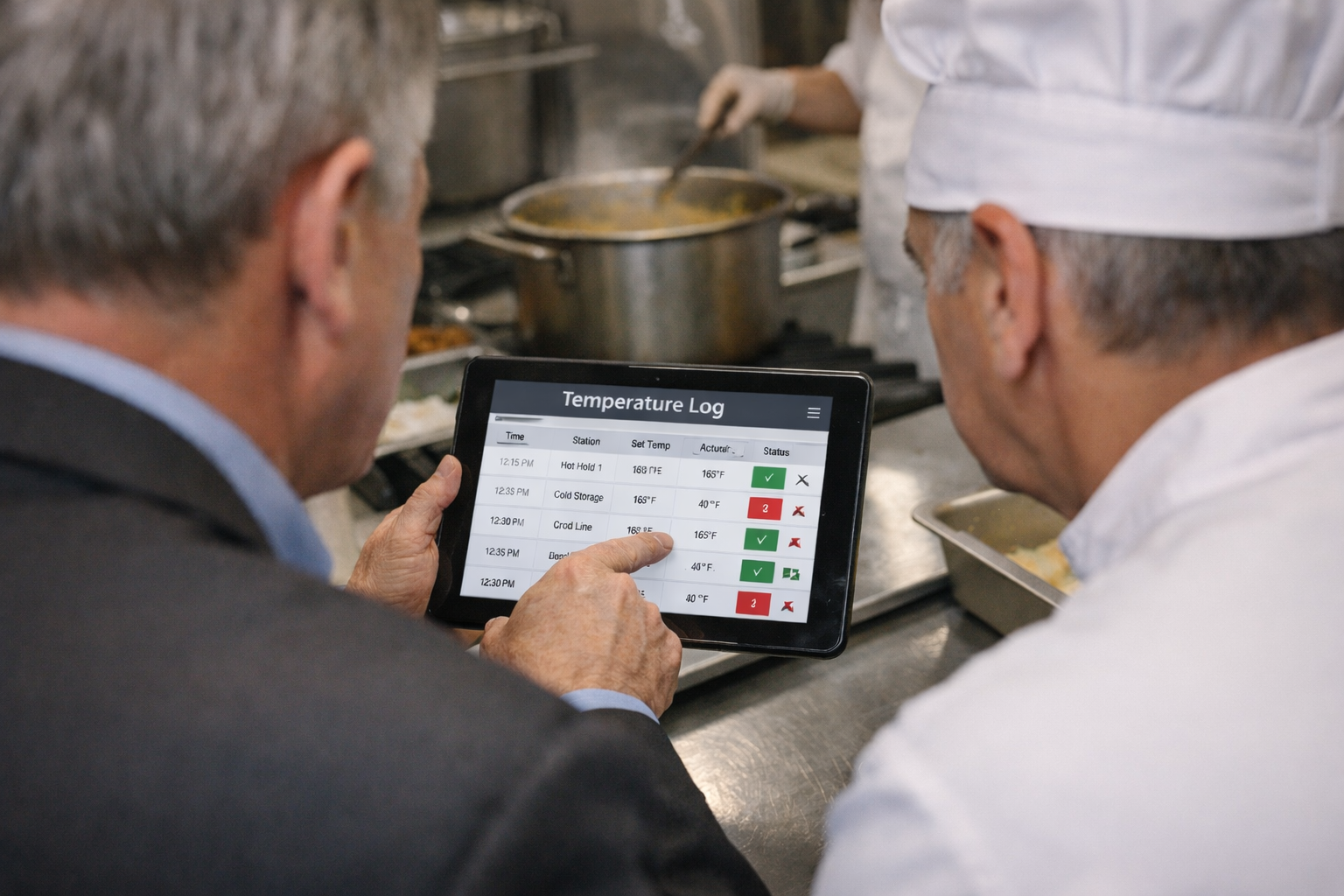
Senior care kitchen automation is often introduced as modernization. The conversation centers on efficiency, labor savings, or culinary innovation. For executive directors and operations leaders, that framing is incomplete.
In senior care, the kitchen is not simply a production environment. It is a daily operational system that touches compliance, staffing stability, documentation integrity, and resident safety. When variability enters this system, it rarely stays contained. It surfaces in survey findings, supervisory workload, and administrative exposure.
The central question is not whether automation is advanced enough.
It is whether your current operation is stable enough to benefit from it.
Automation readiness begins with self-assessment.
1. Where Does Consistency Depend on Individuals?
Most senior care kitchens operate with documented menus, regulated diet orders, and defined safety standards. On paper, the system appears structured.
In practice, performance often depends on specific individuals who maintain flow through experience.
- When a strong dietary lead is absent, does execution remain consistent?
- When onboarding accelerates, does timing coordination slip?
- When census rises, does documentation discipline weaken?
If performance stability shifts noticeably with staffing changes, that is not a compliance failure. It is a design signal.
Automation does not replace leadership. It reduces process variability in areas that currently rely on memory, habit, or informal correction.
Readiness begins by identifying where stability depends more on tenure than on system structure.
2. Can You Map Drift Before It Becomes a Citation?
Food-related deficiencies rarely begin as dramatic breakdowns. They begin as small inconsistencies.
- A temperature check recorded late.
- A substitution made informally to accommodate a preference.
- A tray held longer than expected before delivery.
Individually, these moments feel manageable. Over time, they create exposure.
Before evaluating automation vendors, leaders should trace the lifecycle of a therapeutic meal from cook completion through delivery and documentation. The goal is not fault-finding. It is visibility.
- If documentation requires reconstruction rather than retrieval, risk is embedded.
- If verification depends on informal double-checking rather than structured checkpoints, drift is embedded.
If a surveyor requested verification today, would your system produce it immediately and confidently?
Automation can introduce timed cycles, digital checkpoints, and structured logging. But those tools only stabilize what leadership has already identified as vulnerable.
Readiness requires visibility first.
3. Is Staffing Variability Designed Around or Reacted To?
Workforce churn in senior care is not unusual. It is recurring. That does not mean kitchens are unstable. It means workflow must assume transition as normal operating reality.
Even with documented menus and diet protocols, execution stability can fluctuate when team composition changes.
New hires may understand the recipe but struggle with pacing. Experienced staff may compensate until volume increases. Supervisors may spend disproportionate time correcting variance.
When turnover is predictable, workflow design must assume transition as normal.
Automation readiness questions here are practical:
- Does quality remain consistent across shifts?
- Does temperature integrity degrade during onboarding cycles?
- Do supervisors spend time correcting portion and timing variance that could be structurally controlled?
If execution reliability fluctuates with staffing cycles, workflow design may be overly dependent on manual discipline.
Automation, in this context, is not about labor reduction. It is about embedding repeatability so performance does not oscillate with turnover.
4. Does Infrastructure Support Stabilization?
Many senior care kitchens evolved over time. Tray lines expanded. Dining rooms decentralized. Holding procedures adapted to feeding schedules.
Readiness requires evaluating integration friction, not square footage alone.
- Would automation fit without disrupting tray flow?
- Are holding and transport procedures disciplined enough to preserve temperature precision?
- Does documentation generated by the system align with survey expectations?
Precision cooking only delivers value if downstream handling protects it.
Infrastructure stability determines whether automation reinforces the system or complicates it.
5. Are You Prepared to Pilot with Discipline?
Automation initiatives succeed when treated as operational stabilization trials, not technology demonstrations.
Before launch, leadership should define:
What specific instability are we trying to reduce?
Temperature variance? Documentation reconstruction? Supervisory correction load?
KPIs should reflect structural outcomes, not novelty metrics. In senior care, a meaningful pilot typically spans 6–12 weeks to account for onboarding cycles and service variability.
Scaling should only occur if variance narrows and oversight load stabilizes.
If automation reduces dependency on specific individuals and increases execution consistency, it is functioning as intended.
If it does not, the issue is rarely the hardware. It is the operating model.
How to Begin
If you are evaluating kitchen automation in senior care, begin with operational mapping before vendor comparison.
- Identify where variability enters the system.
- Identify where documentation is reconstructed rather than retrieved.
- Identify where consistency depends on specific individuals.
Stability first. Technology second.
Communities that approach automation as infrastructure for operational consistency—not modernization signaling—make stronger decisions under compliance pressure and workforce variability.